
2025
Fermentation barrel for Verdeser
Redesign of a modular, sensorized 304 stainless steel fermenter for an artisanal cassava liquor producer: bus-slot architecture, structural validation, Taguchi design of experiments and cost and reliability analysis.
- Mechanical design
- CAD
- FEA simulation
Client and problem
Verdeser is a sustainable venture that produces cassava liquor and reuses its by-products: settled starch and pulp are turned into products such as cassava salt and fermented starch. It fermented in polymer barrels with several problems: the pulp floated and disrupted fermentation, there was no way to monitor internal conditions, cleaning was difficult and there was a risk of cross-contamination between batches. Its production target is 1,000 L per month.
It was the Mechanical Engineering Project 3 (IMEC 3709), in a team of six students that I led.
Requirements
We translated customer needs into design metrics with a macro-heuristic built with AHP, weighting customer needs (38.5%), engineering quality (30.8%) and financial analysis (30.8%), and a House of Quality (HOQ) that mapped each need to measurable variables: sealing pressure, percentage of solids in the liquor, cleaning time and content visibility.
Architecture
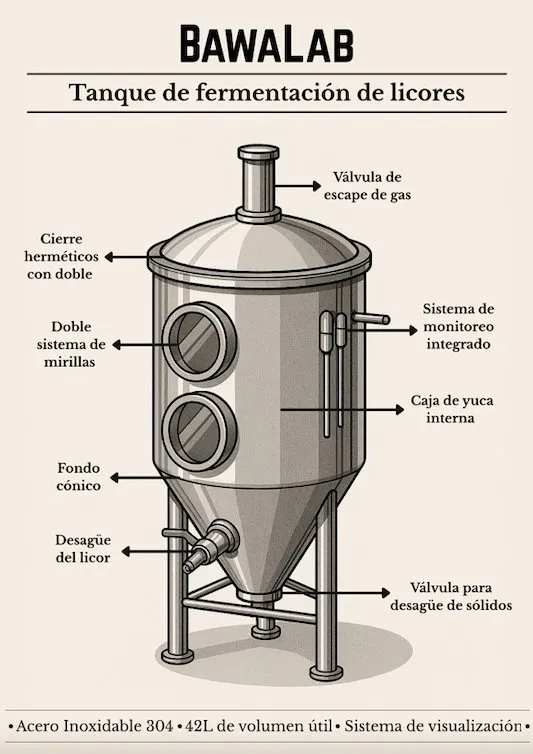
A 42 L cylindrical barrel with a conical bottom, in 14-gauge (1.9 mm) 304 stainless steel sheet, with welded 1020 steel legs. From the functional diagram we grouped functions into six physical chunks on a bus-slot architecture: the tank acts as a bus to which the other subsystems attach through sanitary ferrules and clamps.
- Sealed lid with a food-grade EPDM O-ring, quick-release latches and a relief valve for fermentation gases.
- A removable cassava basket in perforated sheet, hanging from the lid, that keeps the pulp submerged.
- Sensor ports for temperature, pH and alcohol concentration, and sight glasses.
- A liquor drain valve and separate starch collection at the conical bottom.
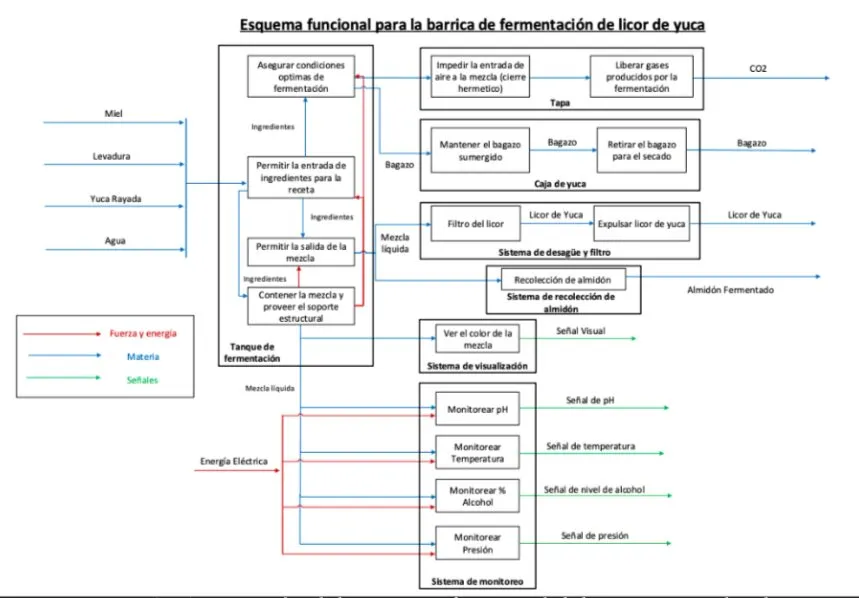 Functional diagram: material, energy and signal flows of the fermentation system.
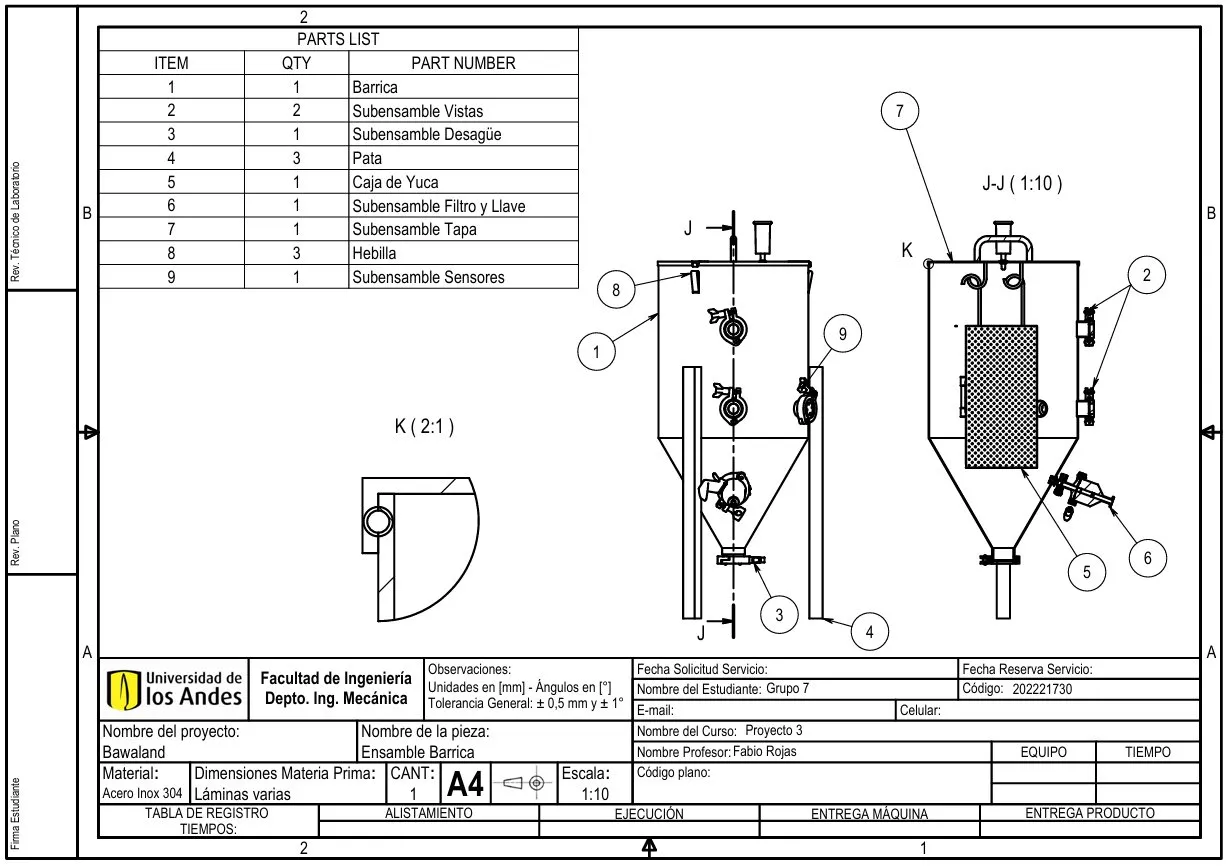 General assembly drawing with parts list.
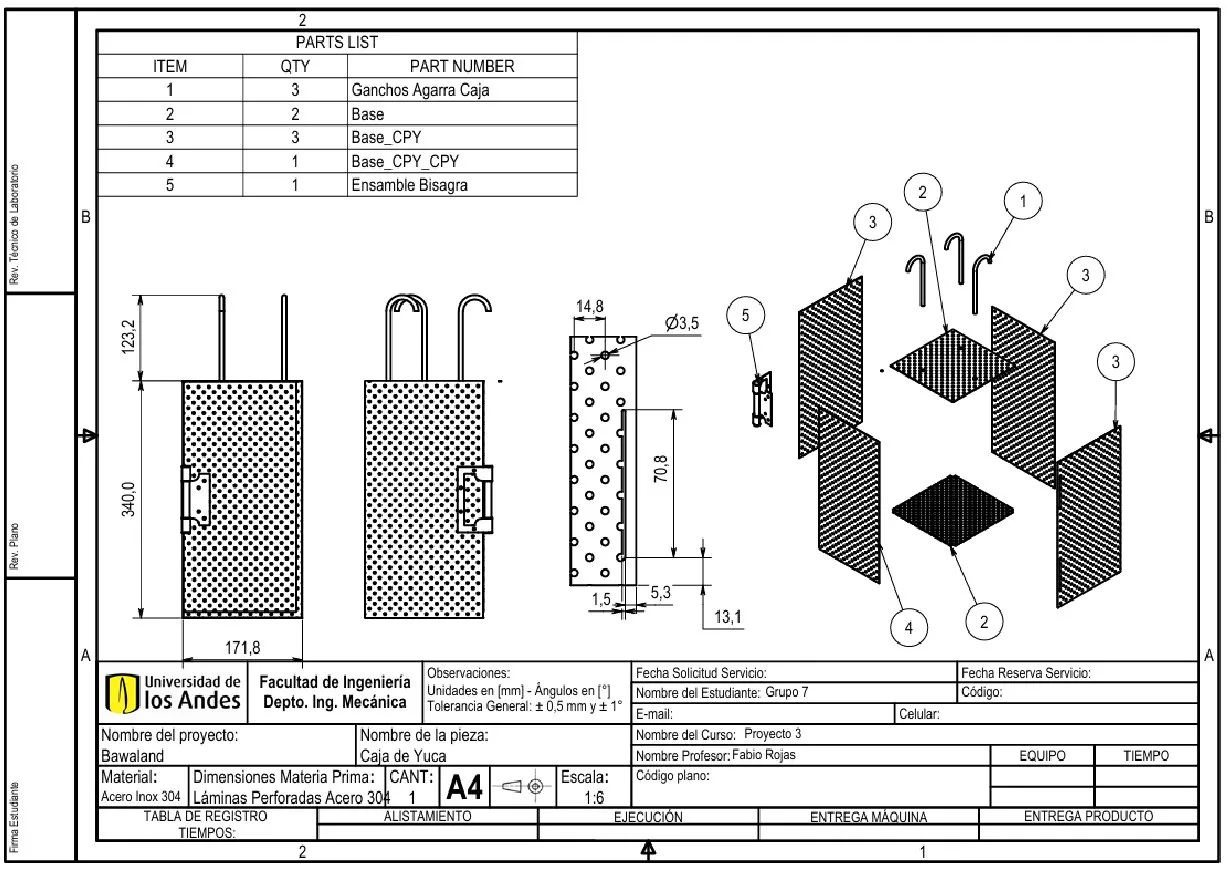 Cassava basket drawing.
Structural validation
- Safety factor by Ullman’s method: 1.1 × 1.25 × 1 × 1 × 1.25 = 1.71. With Granta data, the allowable stress is 292 MPa for 304 steel and 152 MPa for 1020.
- Legs and welds: with a 692 N load (tank, water and cassava), each leg carries 231 N, with a compressive stress of 1.9 MPa. The 2 mm fillet weld (E6010 electrode) works at 0.48 MPa: safety factor of 128.
- Tank simulation in Ansys Mechanical with gravity, hydrostatic pressure and accessory loads, and 5% mesh convergence: maximum deformation of 0.04 mm and peak stress of 3.3 MPa at the tube-to-barrel joint, with a safety factor above 15 across the tank.
- Fatigue: stresses are far below the infinite-life limits of both steels (160 and 150 MPa).
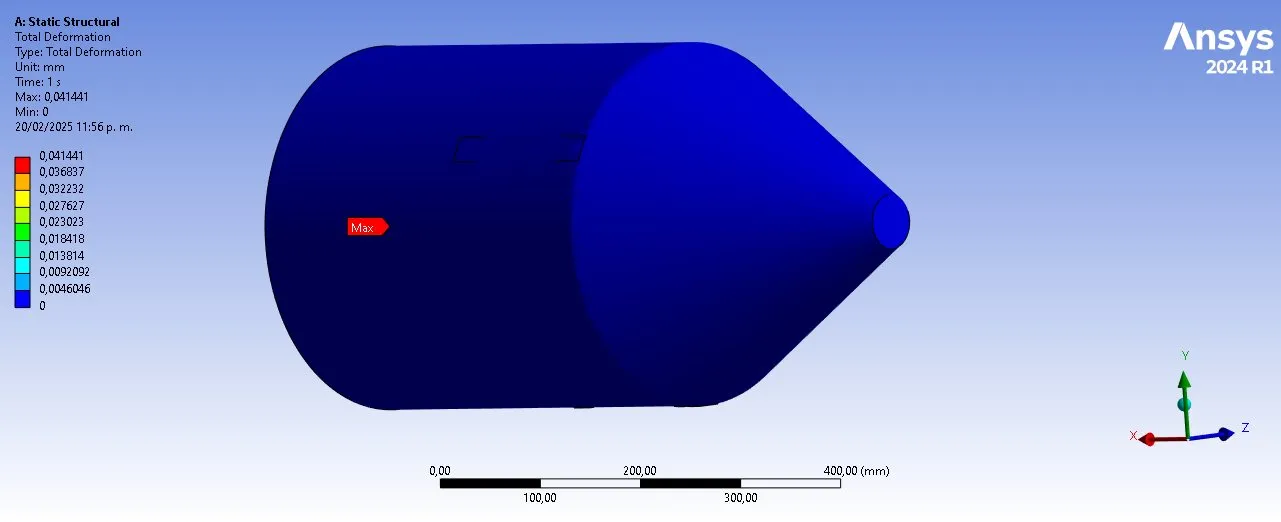 Tank simulation: stress distribution under hydrostatic pressure and accessory weight.
Experimental validation
Following Ulrich and Eppinger’s chapters on prototyping and robust design:
- Cassava basket: perforated acrylic and steel baskets with 2, 3.5 and 5 mm holes. The optimum was 3.5 mm, the best balance of pulp retention, flow, cleaning and manufacturing cost.
- Sedimentation: controlled batch fermentations showed an average sediment height of 159 mm, which set the drain valve position to draw off the liquor without dragging the starch.
- Scaled functional prototype in galvanized steel: leak tests with water and air up to 20 psi and soapy solution, which found five leak points, and successful validation of the temperature, pH and alcohol sensors, with cable passages sealed with epoxy and heat shrink.
- Taguchi design of experiments for the outlet filter: an L4 orthogonal array with two control factors (filter type and diameter) and one noise factor (presence of settled starch), evaluating unfiltered solids, flow rate and the signal-to-noise ratio. The 1-inch metal mesh was the most robust configuration.
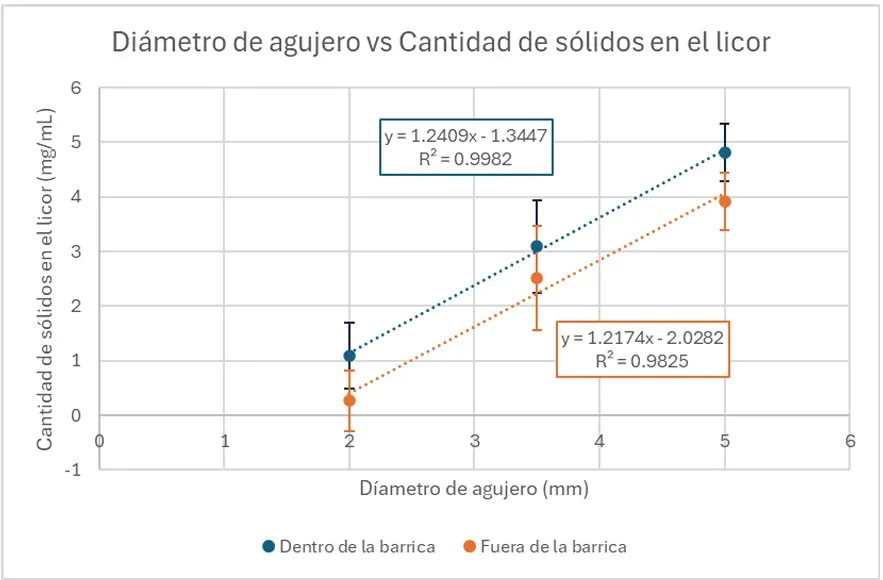 Hole diameter versus solids in the liquor.
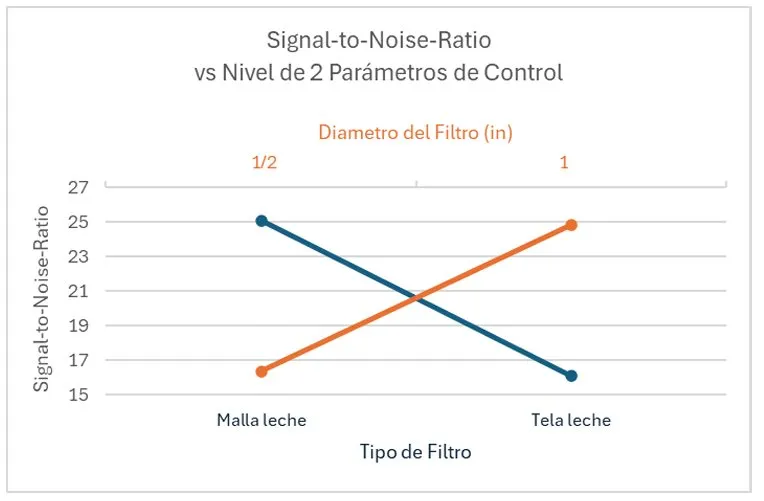 Signal-to-noise ratio from the filter design of experiments.
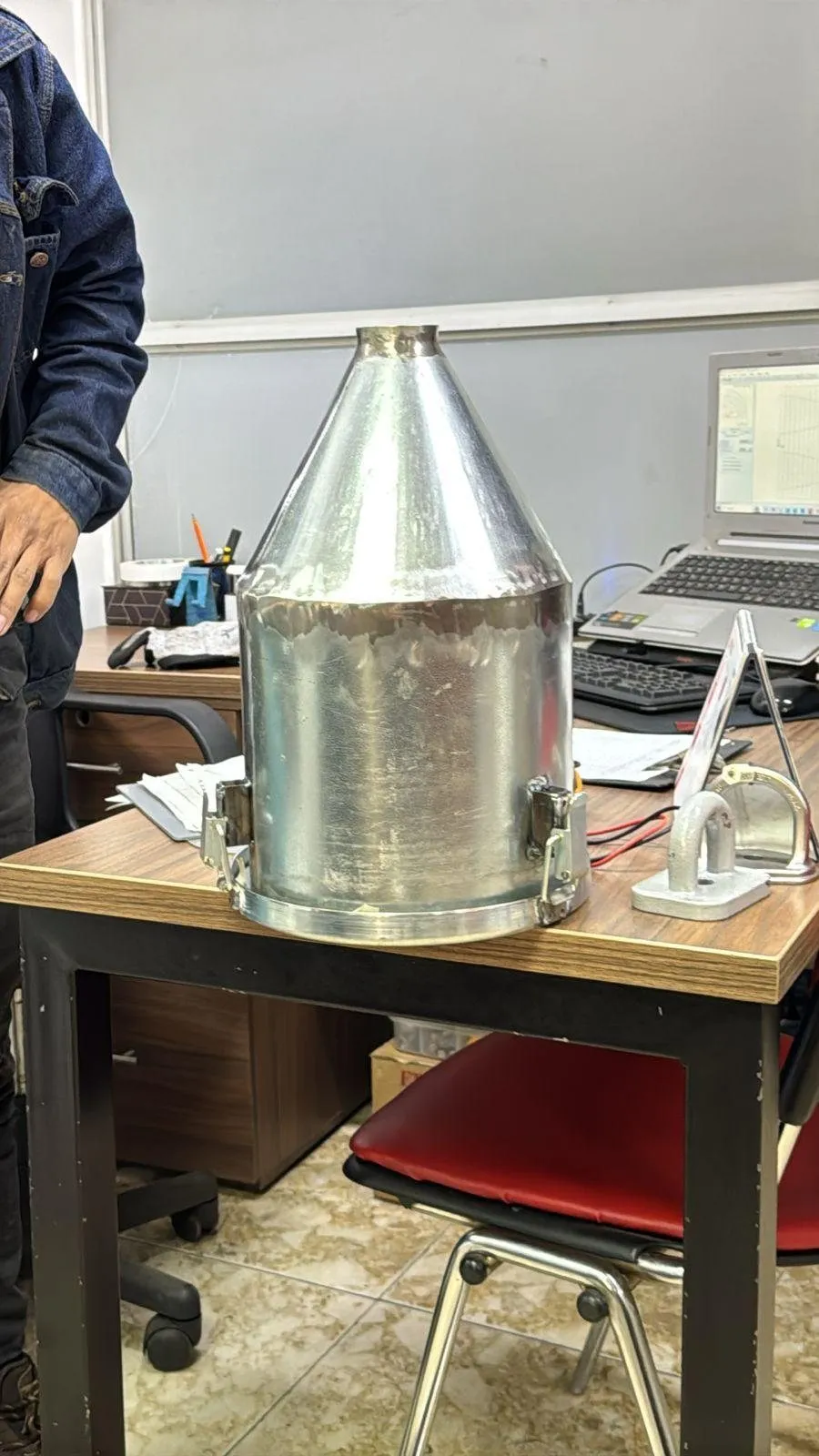 Scaled functional prototype.
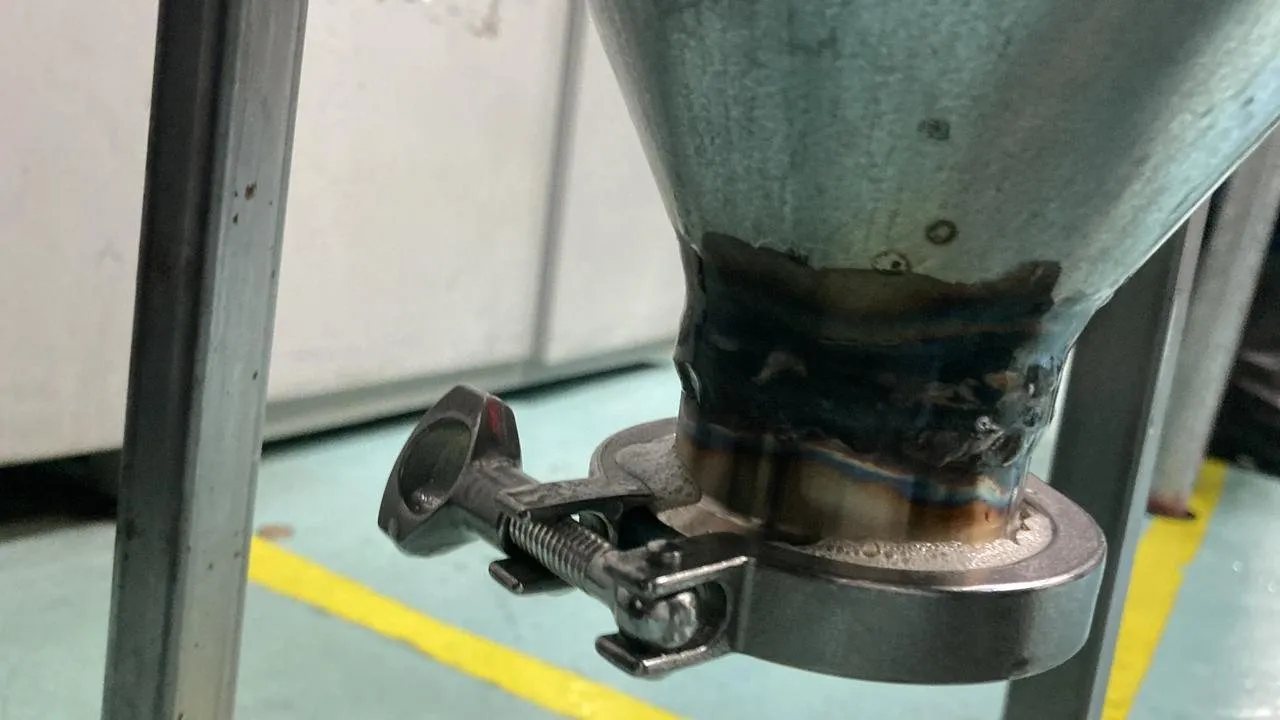 Sanitary ferrule and clamp joint.
Manufacturing, cost and reliability
- DFM and DFA: the assemblability score, assessed with 13 guidelines, improved every iteration until it stabilized in the final version, thanks to sanitary ferrules, standard clamps and off-the-shelf parts.
- Design for cost (DFC): breakdown by subsystem into manufacturing, component and labor costs, following Ullman, and analysis of unit cost versus production volume.
- Reliability: from component failure rates, estimated reliability is 76% without maintenance and exceeds 90% with an inspection and replacement plan for gaskets, valves and clamps.
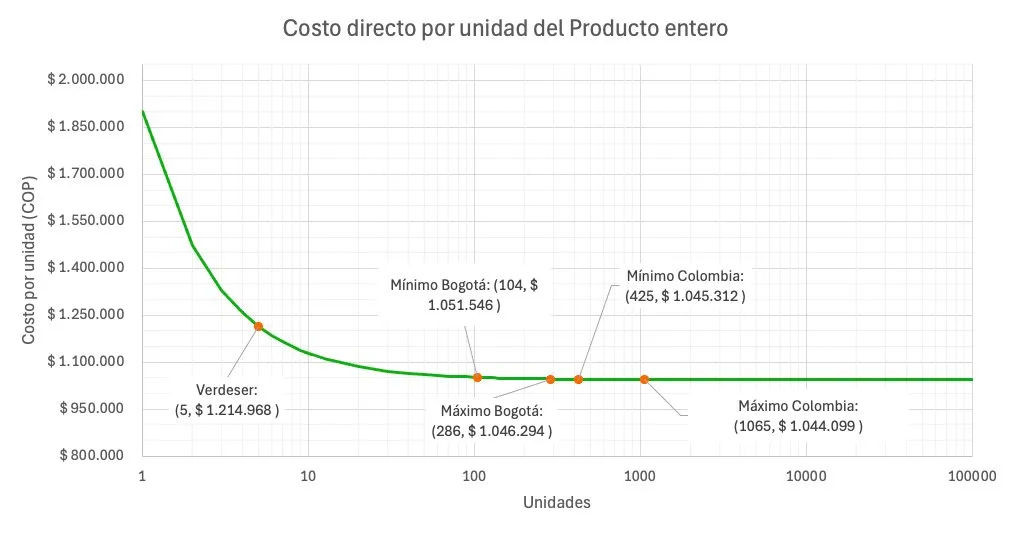 Unit cost versus production volume.
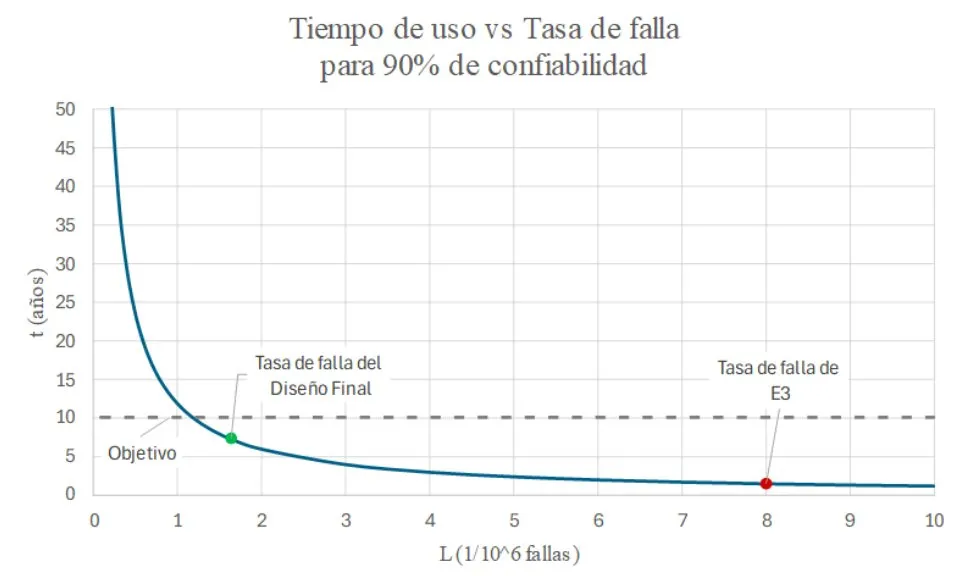 Usage time versus failure rate for 90% reliability.
We delivered a manufacturing manual with shop drawings and an economic proposal for the client.
Mechanical Engineering Project 3, Uniandes (2025). It’s part of the University chapter.