2026
Chitin–cellulose biofilter for microplastics, with life cycle assessment
A regenerable adsorbent foam made from shrimp waste to remove microplastics from drinking water. With this project I learned to run a life cycle assessment (LCA) in openLCA, from scope definition to interpretation, to find where the environmental burden of a clean technology really lies.
- Life cycle assessment (LCA)
- Software
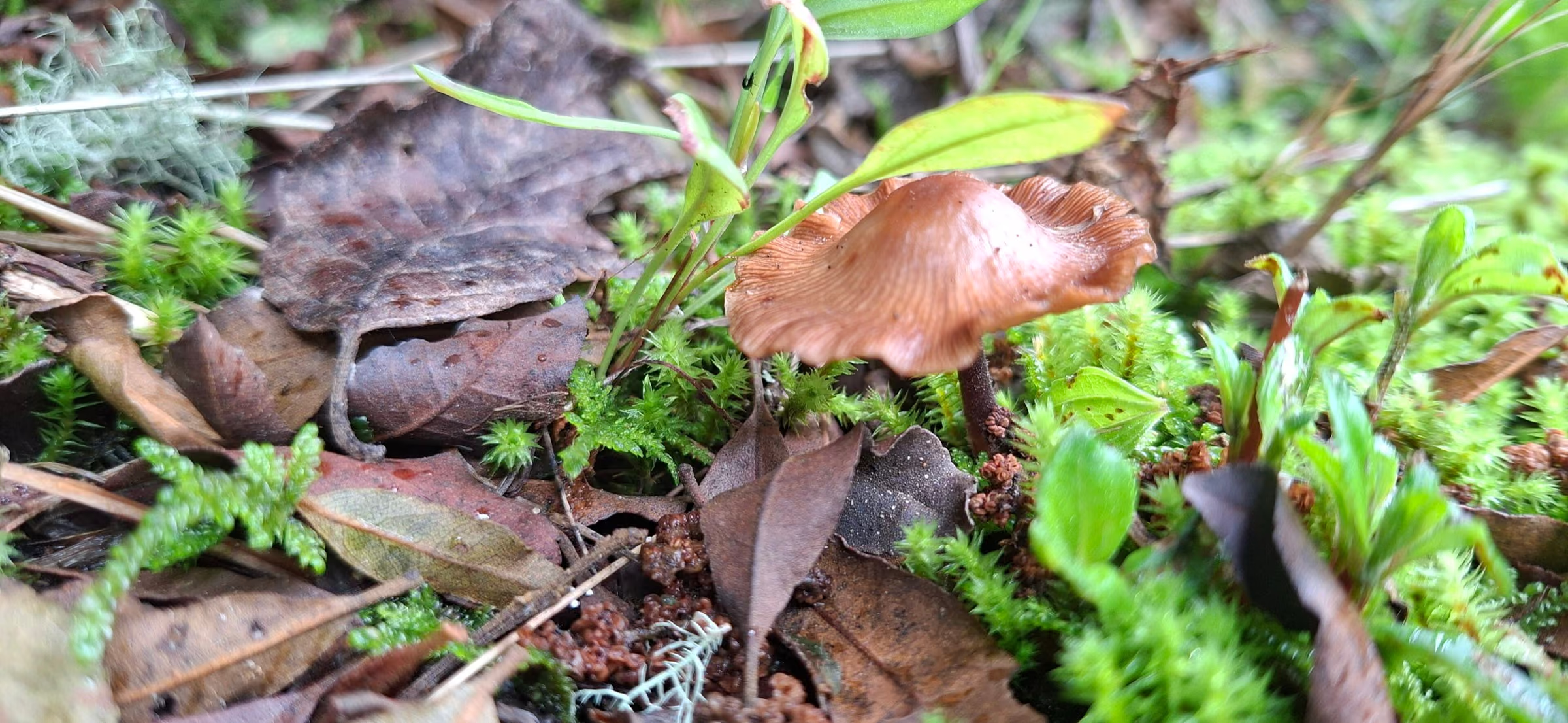
A technology that cleans water also consumes energy, solvents and materials. This project, from the Polymer Sustainability course, developed a biomass filter for microplastics and used a life cycle assessment to evaluate whether its benefit outweighs its own footprint. It was the project where I learned the most about LCA: how to set a defensible goal and functional unit, build an inventory from literature and in-house measurements, and read the results to make design decisions.
Microplastics in drinking water
Microplastics have already been reported in Colombian freshwater bodies: fibers, polyethylene, PET and polystyrene, for example in the Betania reservoir (Huila) and Luruaco lake. In a survey we ran among Uniandes students and their families, microplastics ranked among the main concerns about drinking water quality.
Technical concept
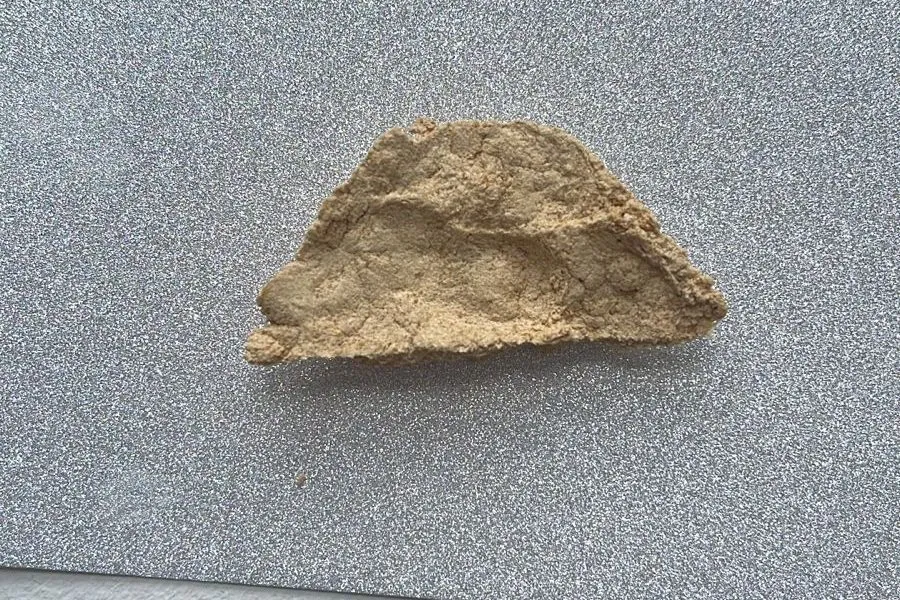
A reusable adsorbent foam of chitin and cellulose (Ct-Cel). Chitin is extracted from shrimp exoskeletons, a waste that today ends up in the ocean or in landfills: Colombia produces about 5,000 t of shrimp a year, up to 70% of which is waste with a chitin content of 12 to 24%. The two fibers bond through hydrogen bridges, without synthetic crosslinkers.
The foam is made by dispersion in acetic acid, homogenization, freezing and freeze-drying (48 h), and is regenerated with DMF (dimethylformamide), rinsing and another freeze-drying step. Its average adsorption capacity is 309.86 mg of microplastics per gram of foam. The recovered microplastics could be upcycled as modifiers in asphalt mixes or through thermochemical routes (pyrolysis).
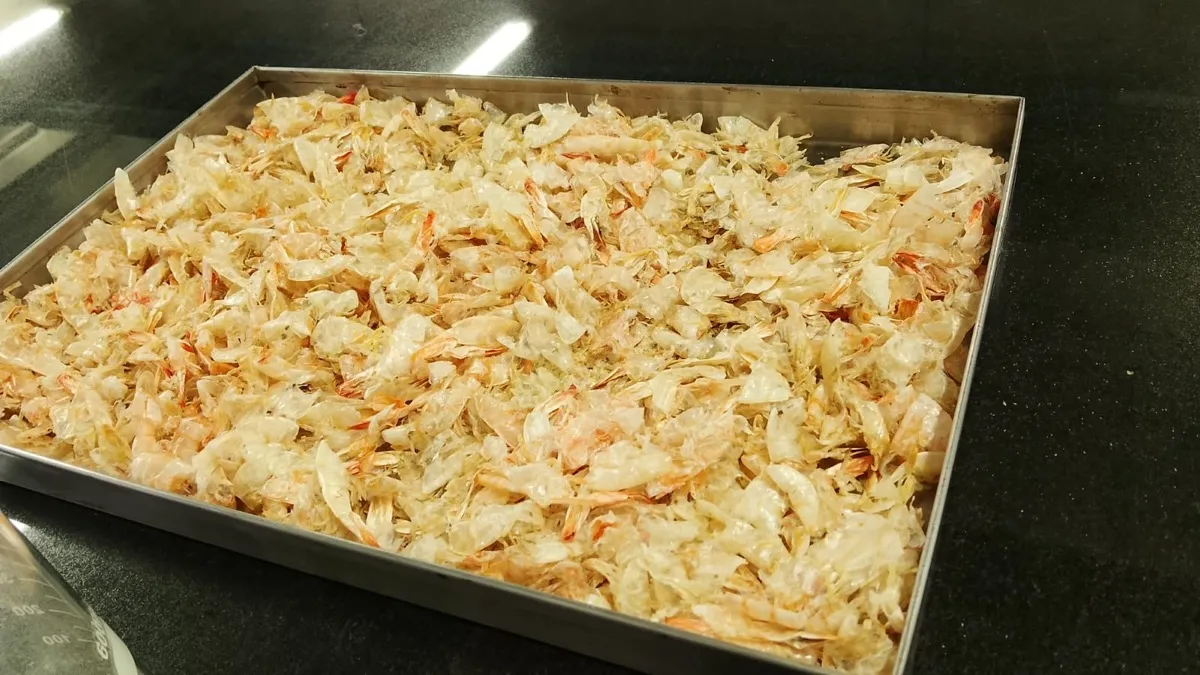 Chitin comes from a waste stream: shrimp shells.
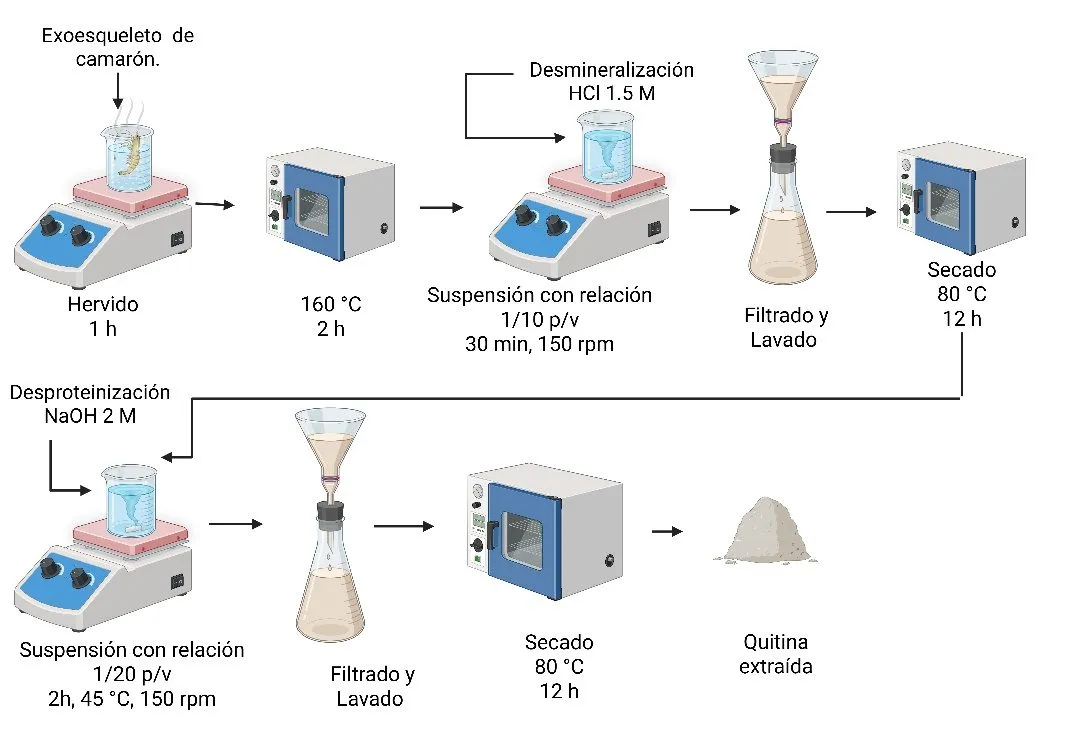 The acid-base route to extract chitin, step by step.
Life cycle assessment
I was in charge of the full LCA in openLCA, following the structure of ISO 14040/14044.
Goal and scope. The study had two goals: determine whether the filter’s net impact is positive, using normalization and weighting to compare categories, and compare two chitin extraction routes: acid-base (HCl demineralization and NaOH deproteinization) and fermentation. The system boundary is cradle-to-gate and includes regeneration: raw materials, foam manufacturing, transport and use with its regeneration cycles. Laboratory equipment, as capital goods, was excluded.
Functional unit. The first proposal was “1 m³ of treated water”, but we corrected it to the removal of 1.0 g of microplastics, with a minimum target removal of 95%. This ties the functional unit directly to the filter’s performance (its adsorption capacity) rather than to an uncertain inlet concentration: from 309.86 mg/g we calculate how much foam must be produced and regenerated per gram removed.
Inventory (LCI). For the acid-base route we used the laboratory inventory of Bashiri et al. (2025) and for fermentation, that of Liu et al. I modeled electricity from the measured power and operating time of the equipment in the ML416 lab at Uniandes: oven (64.8 kWh), stirring hot plate (4.4 kWh), blender (0.5 kWh) and freeze-dryer (47.5 kWh in manufacturing and 31.7 kWh in regeneration).
Impact assessment (LCIA). ReCiPe 2016 Midpoint (H), with World (2010) H normalization and weighting.
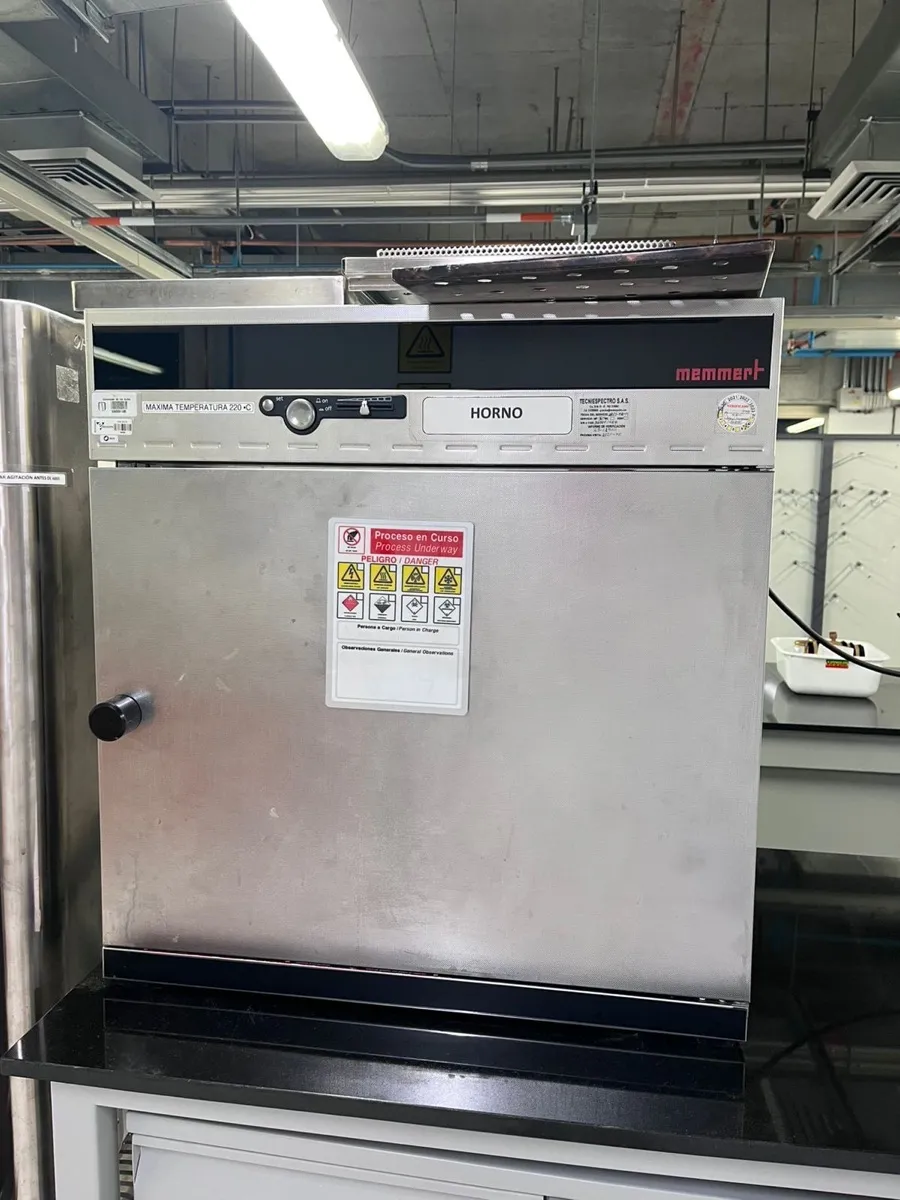 Freeze-drying: the critical point of the impact.
Results and interpretation
- Hotspots. Most of the impact comes from the equipment’s electricity use, mainly the oven and the freeze-dryer, followed by DMF use in regeneration.
- Lab-scale magnitudes. To remove 1 g of microplastics, the process has a global warming potential (GWP) of 239.49 kg CO₂-eq, with relevant impacts on freshwater and marine ecotoxicity. These are high values, typical of a lab inventory without economies of scale.
- Route comparison. The acid-base route has higher impacts than fermentation in every category, because of its reagents and process energy. Fermentation is recommended for industrial scale-up.
- Methodological limitation. ReCiPe’s characterization factors do not credit the benefit of removing microplastics from water. Following Salieri et al., an interim characterization factor of 3,231 PAF·m³·d/g of microplastics removed can be assumed. Assessing the net benefit requires microplastic-specific characterization factors.
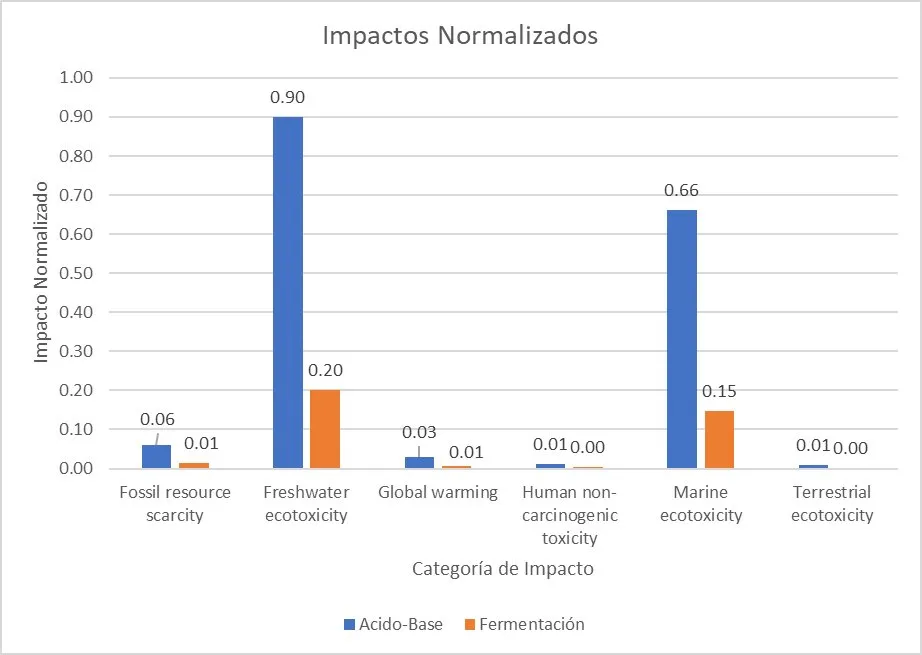 Normalized impacts by category: acid-base route (blue) versus fermentation (orange).
The design conclusion is that the next step is not to change the filter’s chemistry but to cut drying energy and replace the regeneration solvent. That is the value of an early-stage LCA: pointing out where engineering effort is worth investing.
Business model
The value proposition is a household filter as a service: users don’t buy a disposable filter but a subscription in which the company installs a reusable PLA fitting, collects the filter, regenerates it and returns it. It is a circular economy model with recurring revenue:
- Revenue streams: kit installation (COP 269,000), monthly maintenance visit (COP 197,000) and filter replacement every five cycles (COP 86,000).
- Cost structure: fixed monthly costs of about COP 3.5 million, concentrated in payroll and rented freeze-drying capacity, plus logistics and per-customer reagents.
- Financial projection: acquiring 1.5 new customers per month, cumulative cash flow turns positive in month 16, with about 29 customers.
The main risk to validate is the target segment’s willingness to pay for a monthly subscription and how they weigh the environmental benefit against the price.
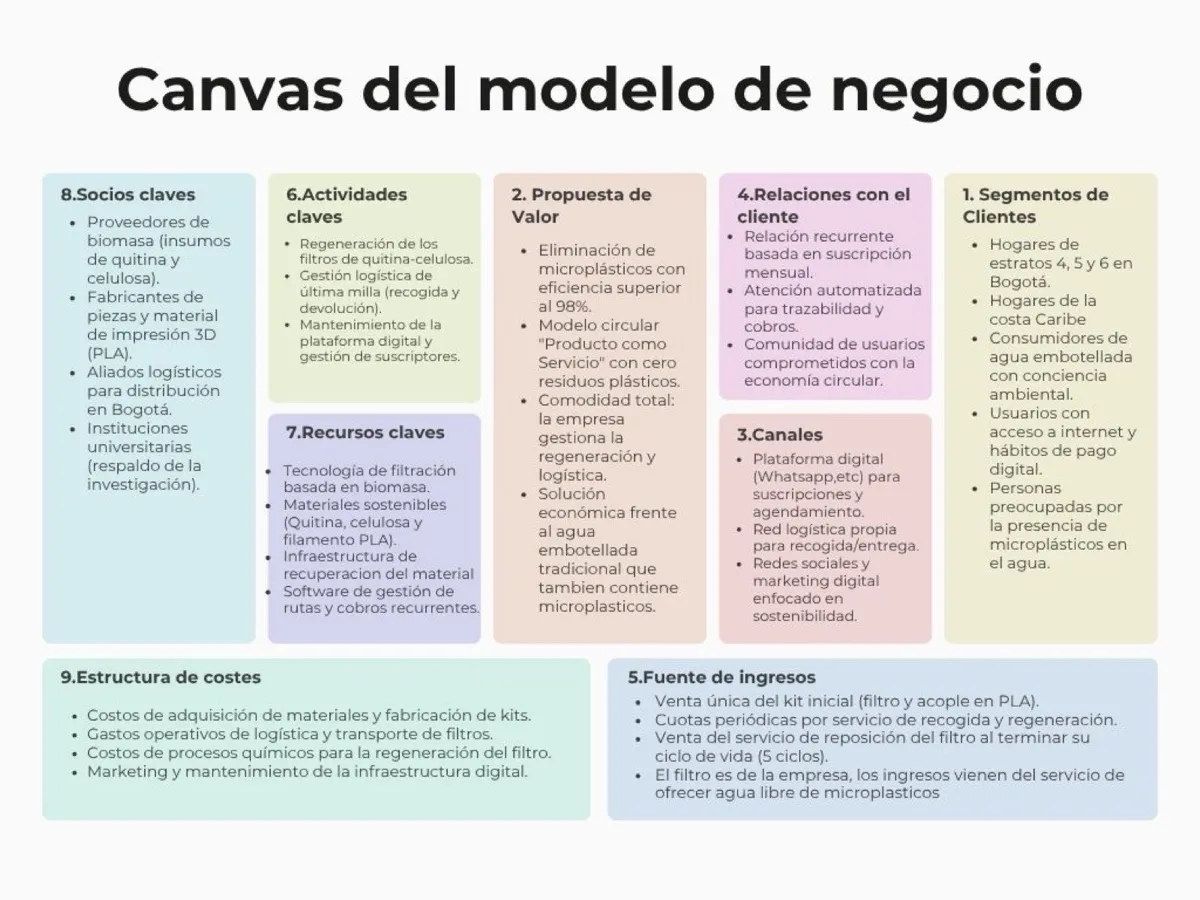 Business Model Canvas.
A project for the Polymer Sustainability course, in a team of three. It’s part of the University chapter.