
2026
R.O.V.E.R. — a 3D-printed sand excavation rover
I led a team of 9 students in designing, building and validating an FPV-teleoperated rover that digs up and recovers objects buried in sand, following the VDI/VDE 2206 methodology and the ASME IAM3D competition rules.
- Mechanical design
- CAD
- Software
- Project management
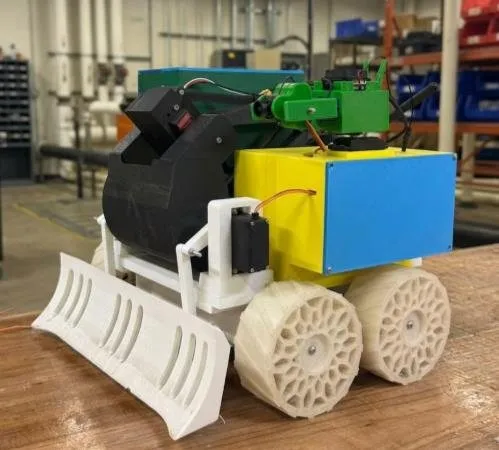
Context and challenge
The R.O.V.E.R. is an unmanned ground vehicle, FPV-operated from an isolated booth and built mainly through additive manufacturing. It must cross a sand track, dig up objects, collect them and deposit them in a container. The design followed the rules of the ASME IAM3D (AY25-26) competition: scoring rewards the mass of objects and sand deposited in 5 minutes, with bonuses for metallic objects and for the share of 3D-printed parts.
It was the Mechanical Engineering Project 4 (IMEC 3710), with professor Alejandro Marañón. I led the whole project, in a team of 9 students: planning, scheduling, systems engineering, subsystem integration and test planning.
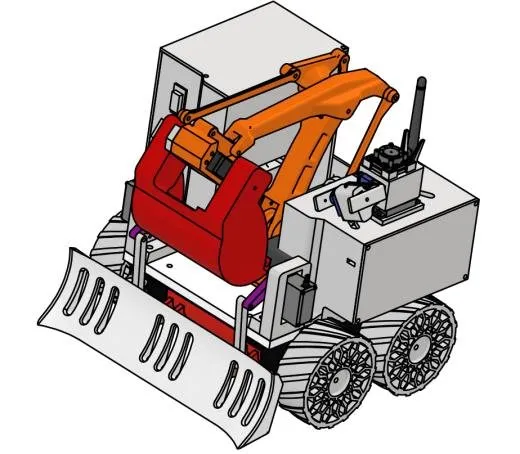 Isometric CAD of the R.O.V.E.R.
Methodology: VDI/VDE 2206
We used the German VDI/VDE 2206 guideline for mechatronic systems development, whose V-model links each level of specification (system, subsystems, components) with its verification and validation. I researched the standard for the team and we used it to structure the whole project:
- System specification: high-level needs (reliability, agility and extraction capability) translated into compliance and performance requirements, each with a defined verification method.
- Functional architecture: six subsystems (chassis, mobility, filtration, extraction, electronics and vision) with their energy, material, information and mechanical load flows.
- Configuration design: alternatives per function, selected with Pugh matrices against the requirements.
- Implementation, integration and validation iterations (checkpoints 4, 5 and 6 of the guideline), each closed with structured testing.
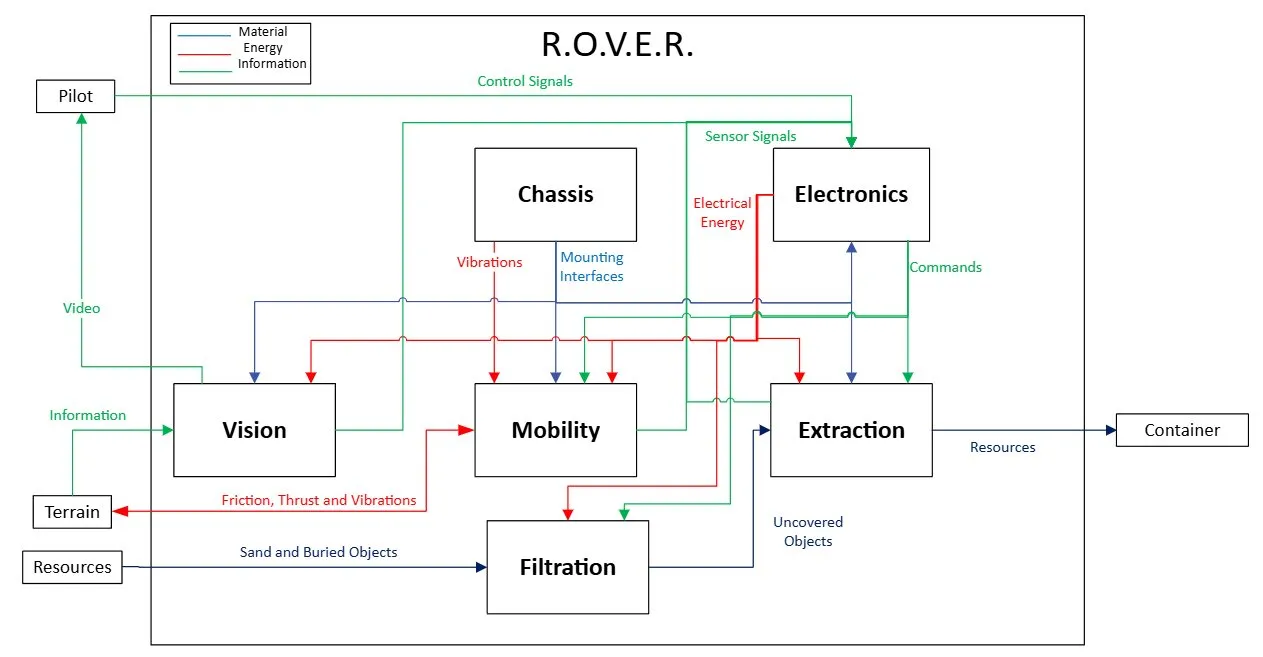 Functional architecture: the six subsystems and their interfaces.
Simulation-based strategy
Before building, we developed a game-like competition simulator to evaluate collection strategies, subsystem layouts and navigation patterns. With 10,000 simulated matches we statistically analyzed the obtainable points and the share of visible versus buried objects.
The finding was that a selective strategy, based only on visible metallic objects, depended too much on chance. The architecture evolved toward continuous front collection: the blade funnels objects toward the arm while the rover keeps moving, which reduces turns and dead time.
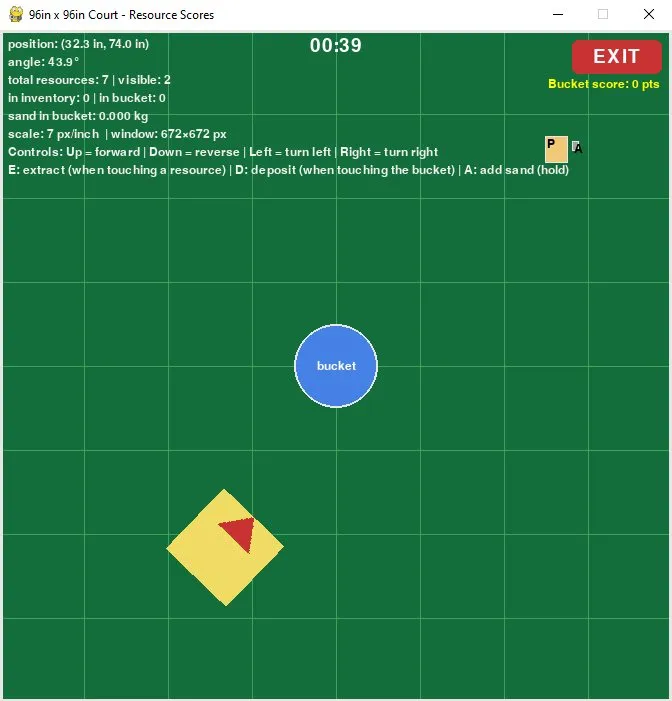 Competition strategy simulator.
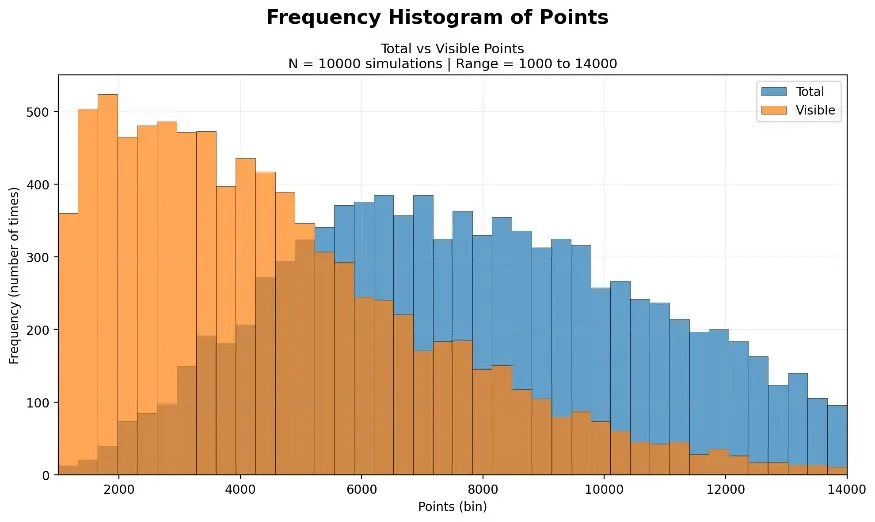 Distribution of obtainable points over 10,000 simulations: total versus visible objects.
Subsystem design
- Chassis: a 3D-printed structure that houses the electronics, keeps the subsystems in position and transmits loads to the mobility system.
- Mobility: four independent DC motors with 10 cm TPU wheels with a slanted tread and 16 grousers of 3 mm, designed from terramechanics literature for traction on loose sand.
- Filtration: a servo-driven bulldozer blade that digs up and funnels objects toward the extraction zone.
- Extraction: an articulated arm with a parallel four-bar linkage that keeps the bucket’s orientation while lifting objects into the container.
- Vision: an FPV camera on a stabilizing gimbal, with low latency for teleoperation.
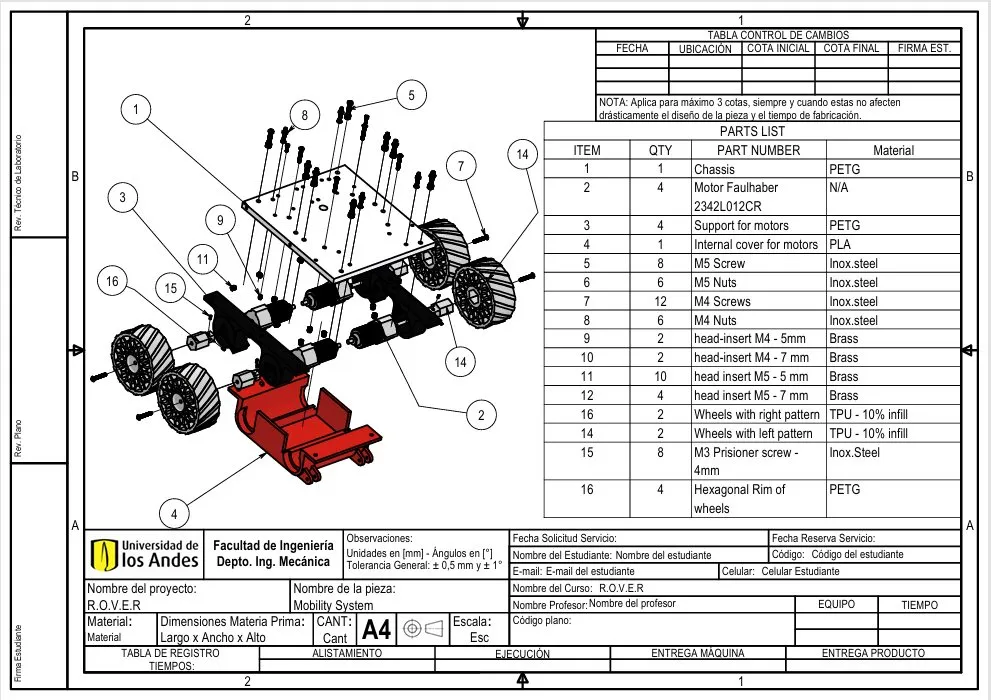 Mobility: exploded drawing with parts list.
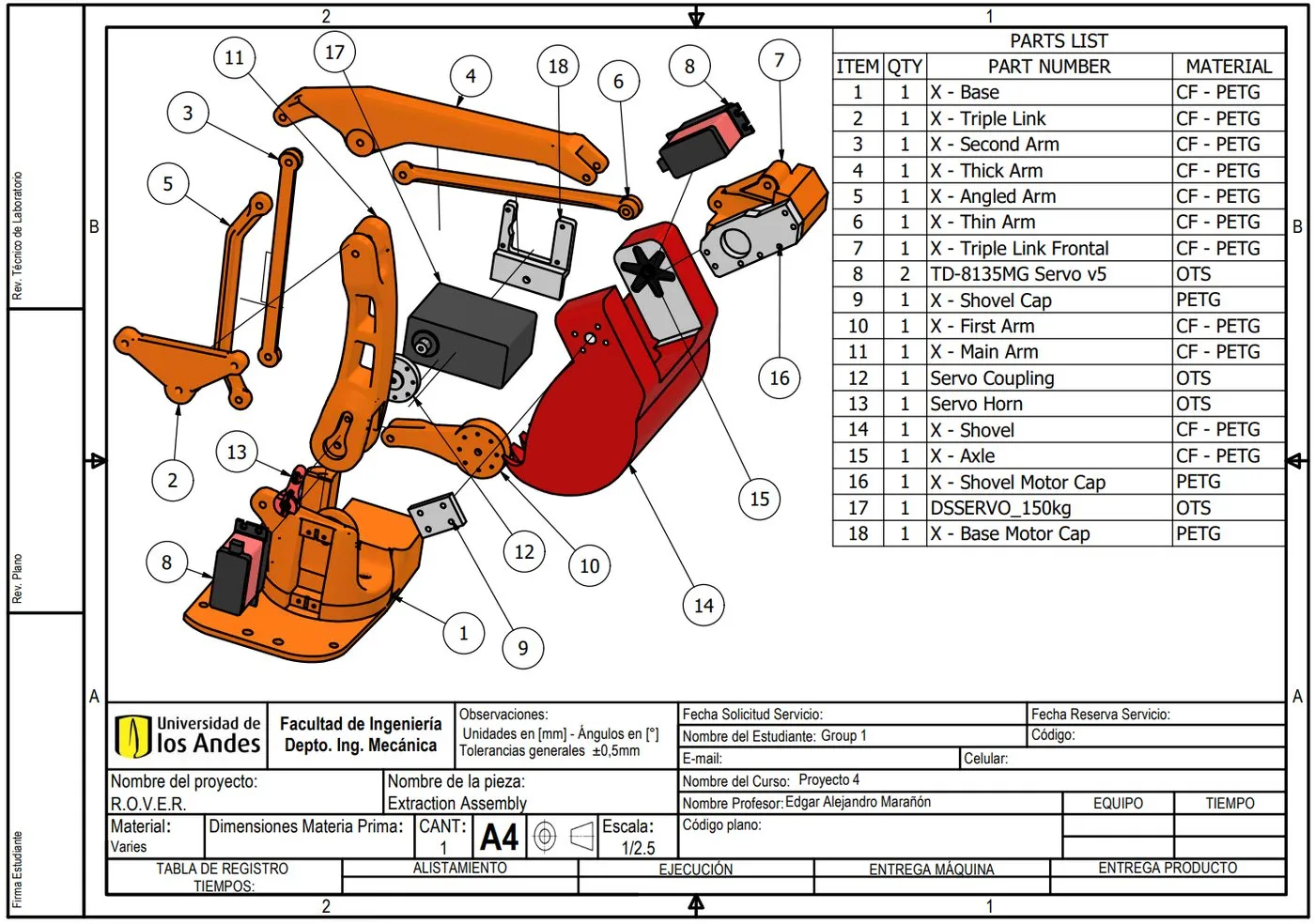 Extraction: four-bar arm, exploded drawing with parts list.
Throughout the project we applied DFAM and DFMA to cut part count, simplify assembly, ease access to each subsystem and maximize the share of printed parts.
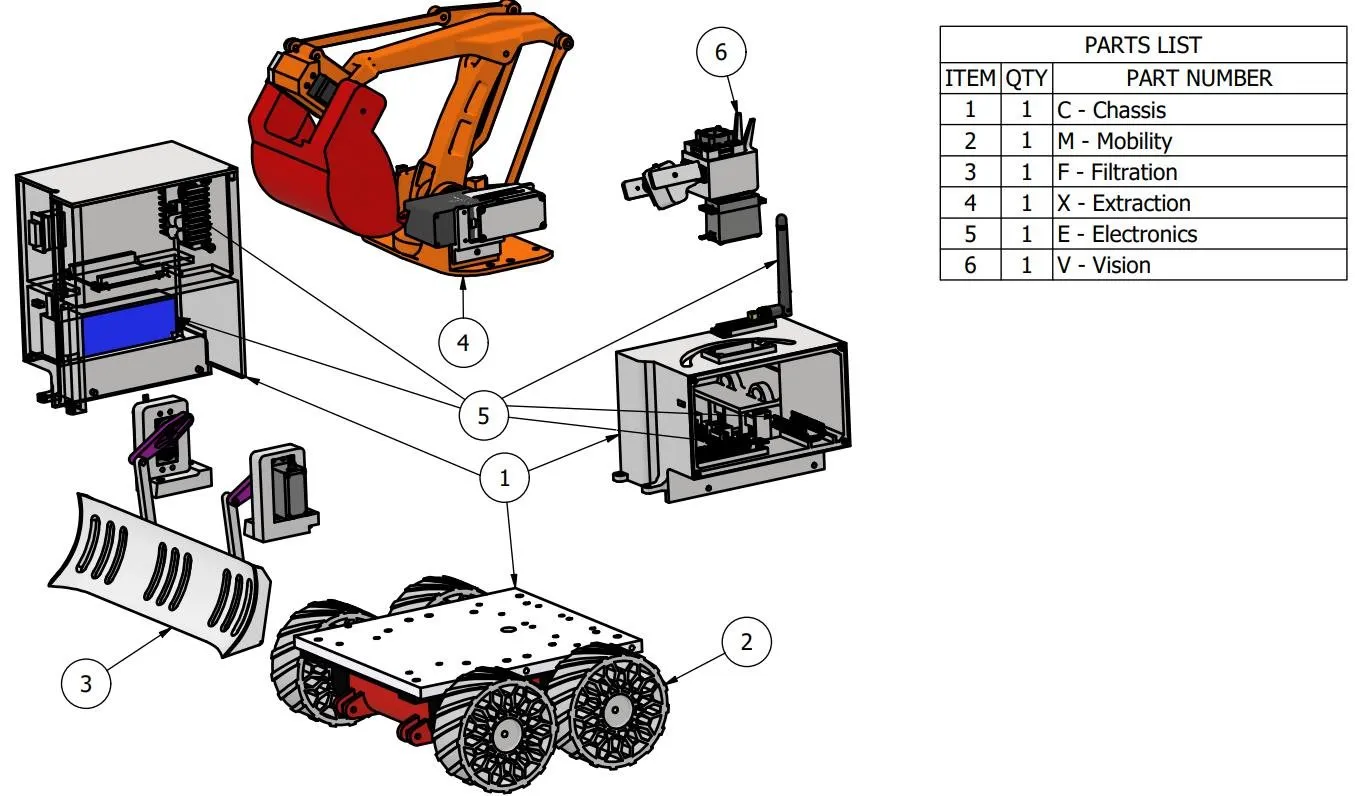 Vehicle assembly drawing with the subsystem layout.
Verification and validation
We ran four complete iterations of design, manufacturing and testing. Each requirement was scored with a compliance heuristic (0, 0.33, 0.66 or 1) under defined validation conditions:
- requirement compliance rose from 36% in iteration 1 to 100% in iteration 4;
- the performance heuristic grew from 0.155 to 0.951 out of 1.00;
- all six subsystems were integrated in iteration 3, revealing dependencies between filtration, mobility and chassis that guided the final adjustments.
In the final evaluation, the rover completed both runs: it deposited 793 g of sand in the first and, in the second, lifted and deposited an aluminum part with 493 g of sand, earning the metallic object bonus.
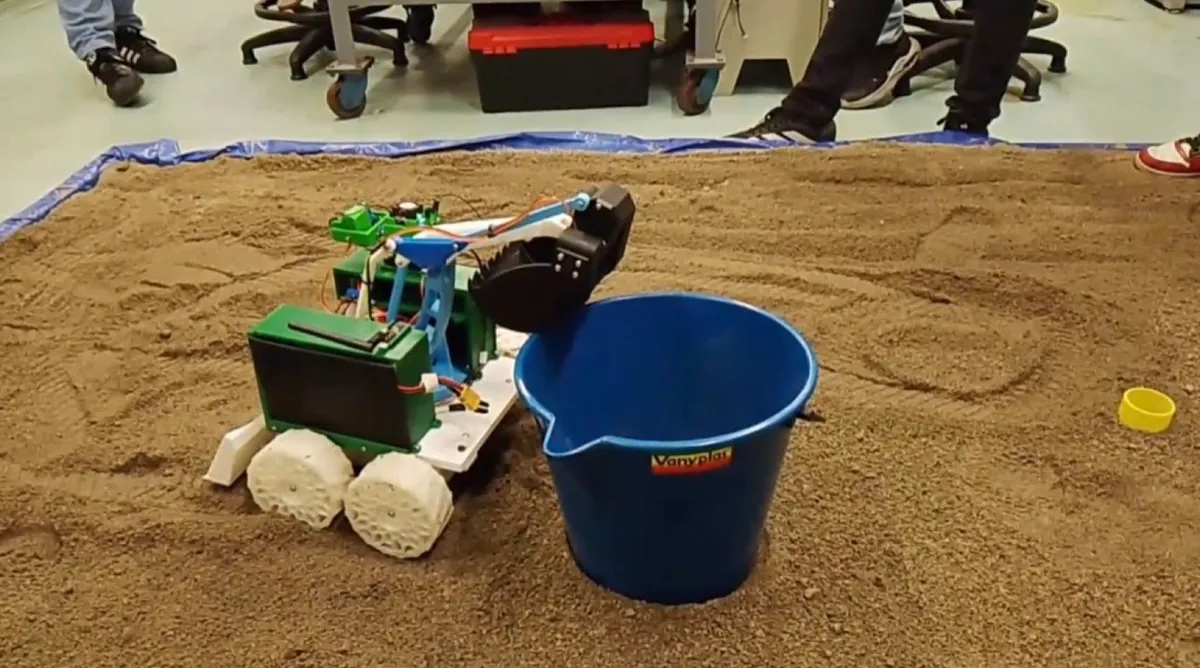 The R.O.V.E.R. on the sand track.
Conclusions
- Leading a large team takes structure. With nine people and six subsystems, a milestone schedule, meeting logs and a shared requirements matrix kept everyone aligned and surfaced integration bottlenecks early.
- Rigorous verification changes decisions. The VDI/VDE 2206 V-model forced us to define from the start how each requirement would be tested. Measuring compliance every iteration made redesign a data-driven process, not a matter of intuition.
- Simulate before building. The strategy simulator changed the rover’s architecture before the first part was printed.
Mechanical Engineering Project 4, Uniandes (2026). It’s part of the University chapter.